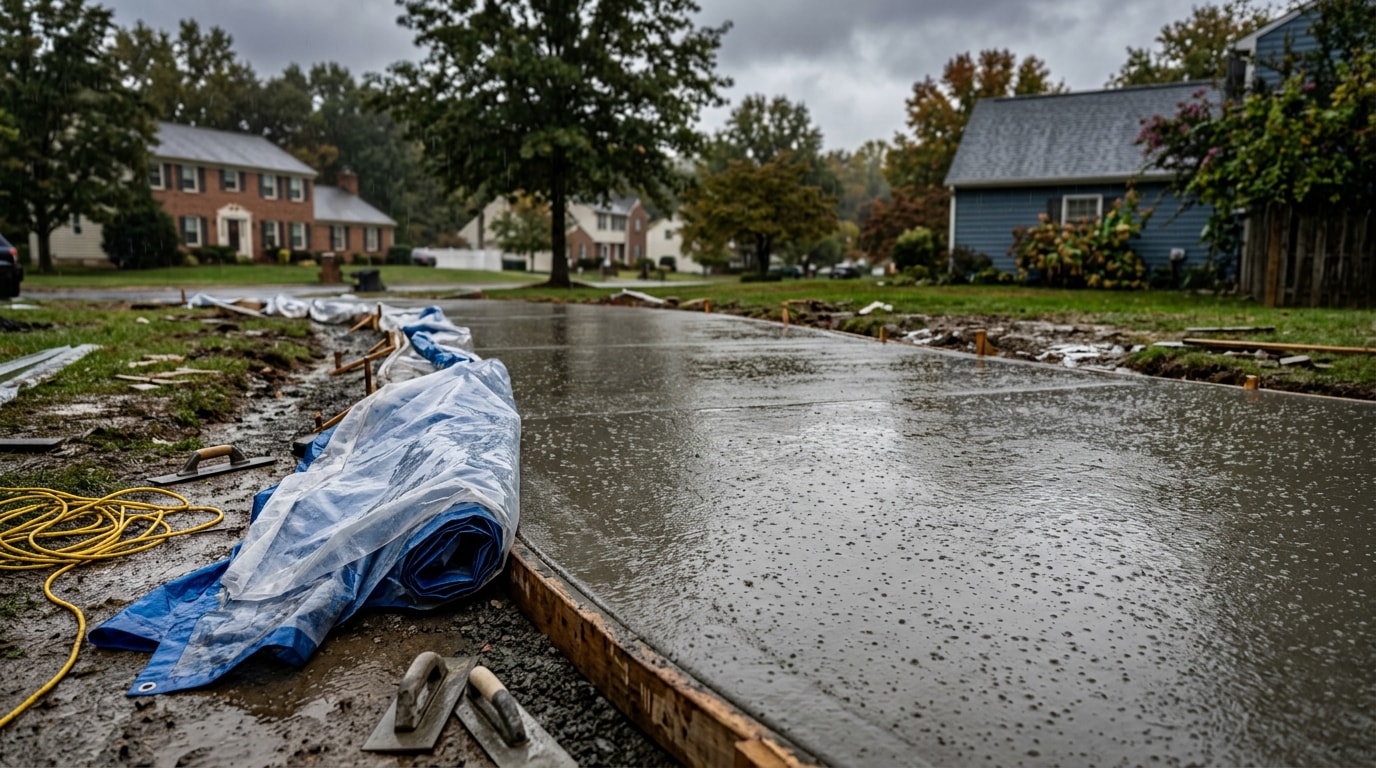
Yes, you can pour concrete in the rain in Baltimore County, MD, but only in light, brief rain with site prep, a stiffer mix, and cover-up materials staged and ready to go. Heavy, sustained downpours are a different story, since they can wreck the surface finish and weaken the slab before it ever gets a chance to cure. Here's how experienced crews decide whether to pour or push the job to another day.
The Short Answer: It Depends on Timing and Intensity
The first two to four hours after concrete is placed is the most vulnerable period, so it needs to stay covered and free from foot traffic. Before that window closes, fresh concrete hasn't developed enough strength to resist surface damage from standing water.
Light, steady drizzle that dampens tools and clothing without pooling is usually manageable with tarps, a stiffer mix, and fast finishing work. A forecast calling for hours of driving rain is a different calculation entirely. On our own job sites across Baltimore County, we've rescheduled more than one driveway pour after watching radar show a line of storms rolling in from the west, and it's almost always the right call when standing water is likely.
Why Rain Threatens a Fresh Concrete Pour
Concrete's character comes down to the water-cement ratio, which is the weight of the mixing water divided by the weight of the cement. Rain landing on fresh concrete adds water exactly where it's least wanted: the exposed surface.
That extra moisture dilutes the surface paste and weakens the top layer. The practical symptoms show up fast. You'll see longer set times, visible dusting where the surface powders under light pressure, and a finish that never quite hardens the way it should.
If you're planning a pour that needs to hold up for decades, it pays to work with a concrete contractor who already builds weather contingencies into the schedule instead of guessing at the forecast.
Light Rain vs. Heavy Rain: What Actually Changes
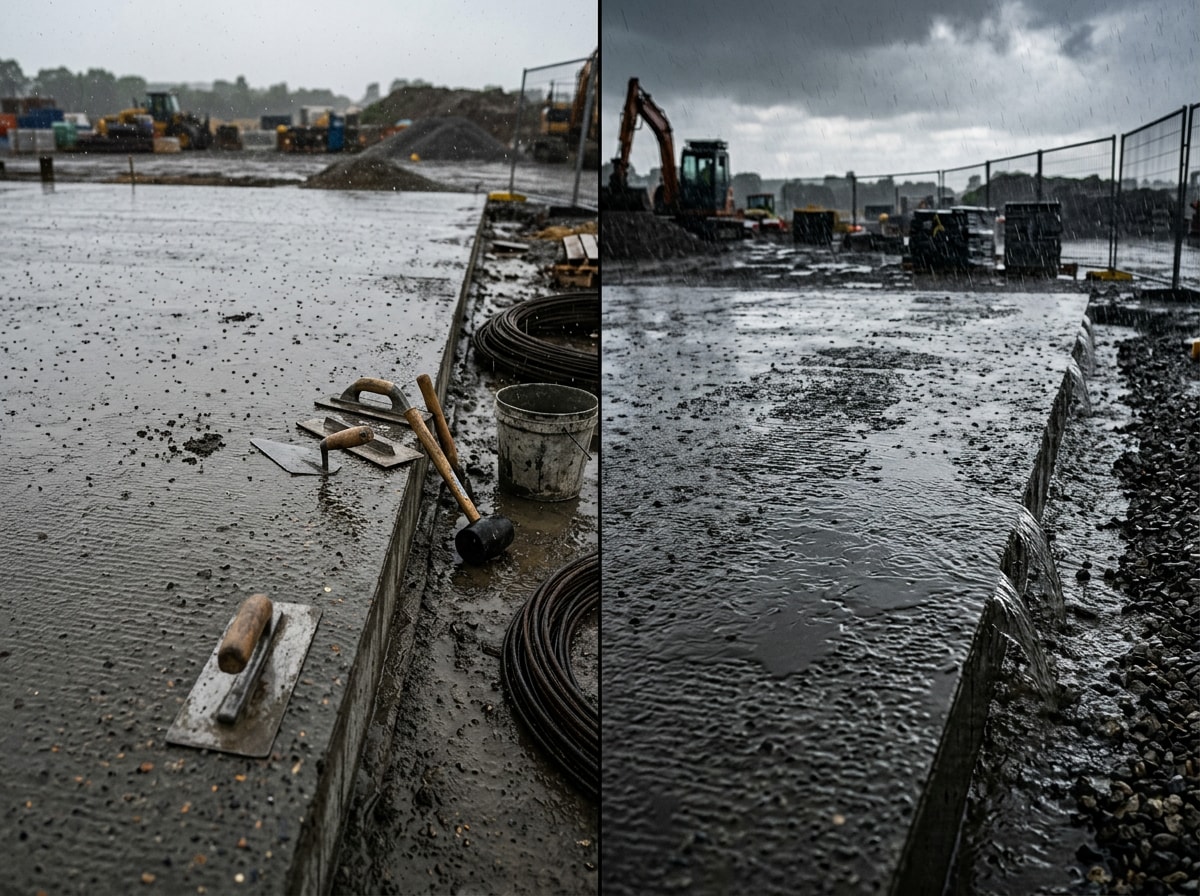
The severity of the rain is a crucial factor in deciding whether a pour is safe to continue. A light, manageable drizzle poses far less risk than driving rain or a sudden downpour that can overwhelm even a well-protected slab.
| Factor | Light Rain | Heavy Rain |
|---|---|---|
| Visible water | Dampens tools and clothing, no pooling | Pools and runs off faster than it can be managed |
| Effect on the mix | Minimal if the pour keeps moving |
Soaked ground and hard rain add extra water that weakens the mix and causes uneven curing
| Recommended action |
Pour, but stay prepared with tarps or plastic sheeting
|
Delay the pour until conditions improve
| Crew response time | Minutes to cover finished sections | Immediate stop and full cover |
A crew that can safely finish a slab in drizzle may need to stop entirely if that drizzle turns into a downpour fifteen minutes later. Watching the radar, not just the sky, is what separates a smooth pour from a redo.
Factors That Decide Whether Your Pour Can Continue
Run through these before the truck arrives. They apply whether you're pouring in Baltimore County or anywhere else with unpredictable weather.
- Type of pour. A deep footing tolerates rain far better than exposed flatwork like a concrete driveway or patio, since the surface finish matters less structurally once it's backfilled.
- Timing of rain relative to the pour. Rain before the truck arrives affects the subgrade; proper site preparation and grading keep water from pooling under the slab. Rain during or right after placement affects the surface finish instead.
- Rain intensity. Light and brief versus heavy and sustained changes the entire risk calculation.
- Protective measures. Whether tarps and plastic sheeting are staged and ready to deploy within minutes.
Running through this checklist before the concrete truck shows up is far easier than improvising mid-pour. If you're staring at a radar app and a scheduled pour, get a free estimate from a licensed crew who can walk the site and make the call before material gets ordered.
Before, During, and After: A Rain-Day Checklist
Before the pour: Check the hourly forecast, stage tarps and plastic sheeting nearby, and consider a stiffer mix design if rain looks likely within the first few hours.
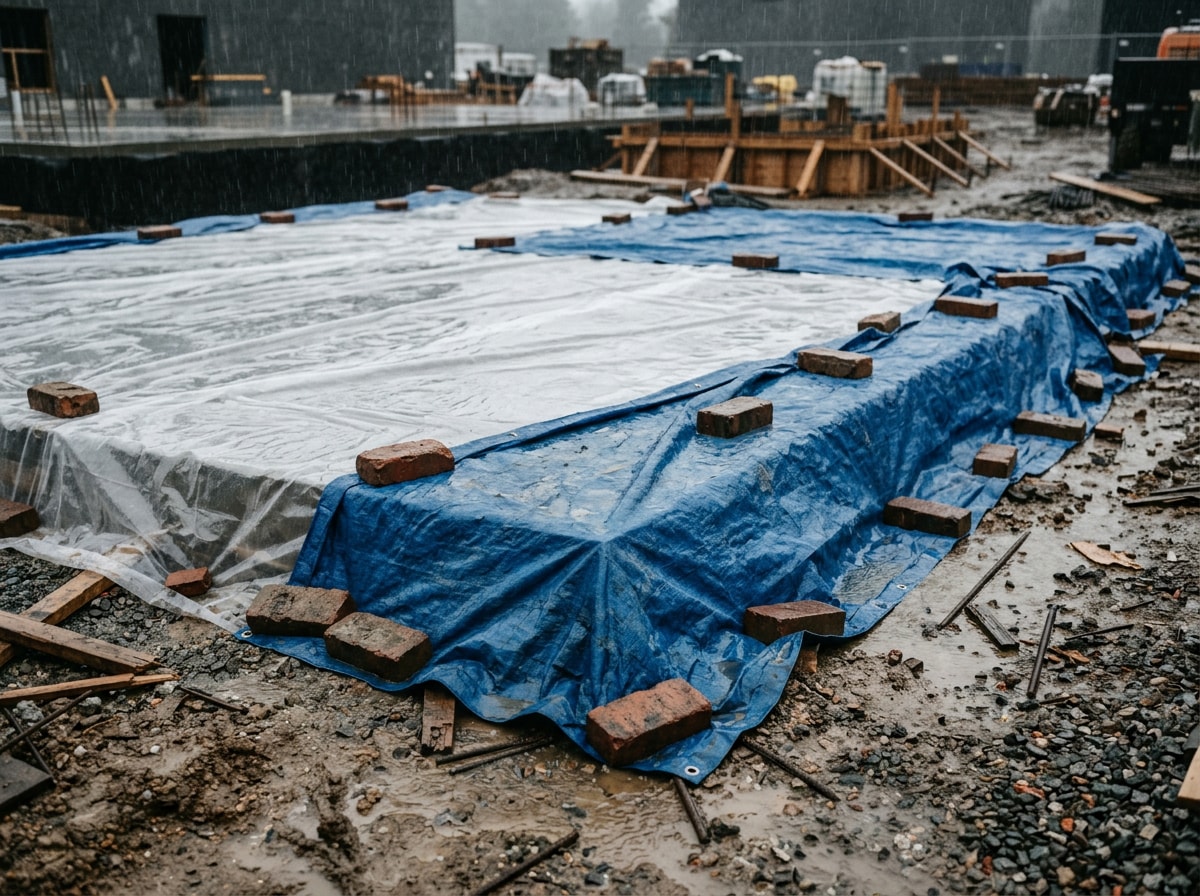
During the pour: Work in smaller sections so each area can be covered quickly. Don't try to "soak up" rainwater with dry cement or work it into a freshly laid surface, since the excess water only compromises the mix and weakens the top layer. Cover finished sections as you move along rather than waiting until the whole slab is placed.
After the pour: If rain arrives anyway, remove standing water carefully without troweling it back into the surface. A proper scratch test after curing can confirm whether any rain damage occurred. Wait until the surface firms up before resuming finishing work with help from a concrete finishing crew.
Driveways and exposed slabs are far more vulnerable to this entire sequence than deep footings, which tolerate incidental rain much better once backfilled.
How Long Before Concrete Is Safe From Rain?
Fresh concrete needs about six to eight hours of dry weather before rain to cure properly, though aiming for 24 to 48 hours protects the project better.
The initial curing period, as defined by federal pavement guidance, is the time between placing the concrete and when final curing operations can safely begin, roughly when the mix reaches its initial set.
Once concrete has achieved that initial set, surface moisture is far less damaging, and consistent moisture actually supports the curing process rather than threatening it. Timing matters more than the calendar date. A pour placed at 8 a.m. has a very different rain-safe window than one placed at 4 p.m.
How to Tell If Rain Damaged Your Concrete
Small cracks, holes, or pitted areas on the surface are a sign that rain may have disrupted the setting process. Dusting and crazing, a web of fine hairline cracks that appears soon after finishing, are the other two signs to watch for.
For a quick check, press a screwdriver into the surface once it's cured. If it scratches easily or crumbles rather than resisting, the surface likely set with too much water. None of these signs are always obvious right away, so it's worth inspecting a rain-affected pour again after a few days.
Baltimore County's Rain Patterns: What Local Data Shows
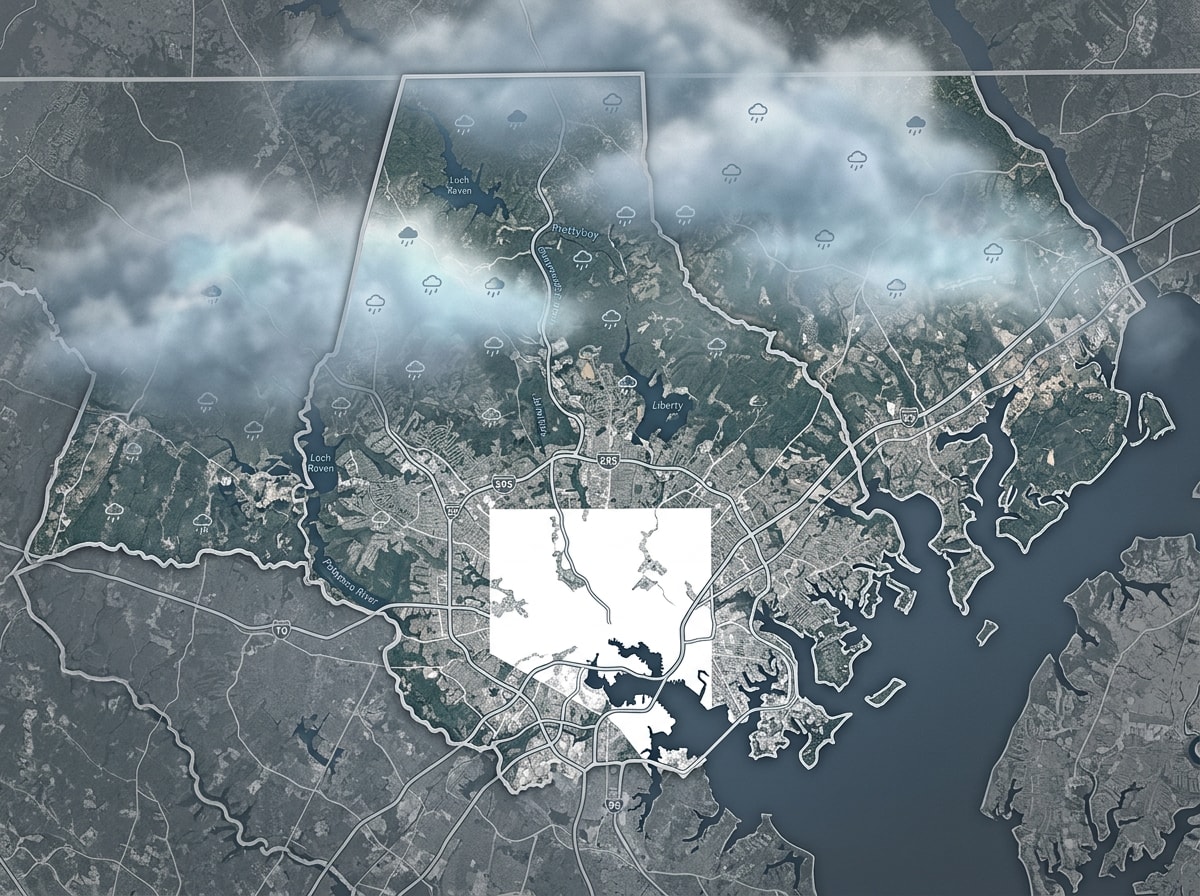
Baltimore County's normal monthly precipitation ranges from about 3.0 inches in February up to 4.3 inches in May , based on figures from the Maryland Department of the Environment. That spread matters for scheduling: spring and early summer pours carry a meaningfully higher chance of a rain delay than a driveway poured in late winter.
That's one reason homeowners across Glen Burnie and the surrounding county lean on a crew that already tracks concrete work in the Glen Burnie area and builds a few days of slack into the schedule during the wetter months. We serve Glen Burnie, MD and the rest of the county, and we plan every residential and commercial pour around the week's actual forecast rather than the seasonal average alone.
Ready to schedule a pour you don't have to second-guess? Visit SEJ Paving or request a free estimate and we'll check the week's forecast with you before anything gets ordered.
FAQ
Can you pour concrete in light rain in Baltimore County?
Yes. In the case of a light mist, pouring concrete is often feasible, and concrete can actually benefit from moisture during the curing process. Keep tarps on hand in case the drizzle intensifies.
Can you pour concrete if it rained the night before?
Usually yes, as long as the subgrade is firm and well-drained rather than saturated or muddy. Standing water or soft, spongy ground means the base needs more time to dry before the pour can safely proceed.
What happens if it rains right after pouring concrete?
Rain hitting before initial set can dilute the top paste layer, causing dusting and scaling. Covering the area quickly with plastic sheeting limits the damage and protects the slab while it finishes setting.
Does covering fresh concrete with plastic cause discoloration?
It can, if the plastic touches the surface and traps uneven moisture, leaving blotchy or darker patches once cured. Tenting the sheeting slightly above the surface allows airflow and helps prevent this.
Can curing compounds protect concrete from rain?
Not on their own. Curing compounds are designed to keep moisture inside the slab, not block incoming rain, so they're no substitute for tarps or plastic sheeting during an active storm.
How can you tell if rain damaged your concrete?
Look for surface dusting, crazing (fine hairline cracks), or a soft spot that scratches easily with a screwdriver. Lower-than-expected strength usually only shows up through cylinder testing on larger commercial jobs.