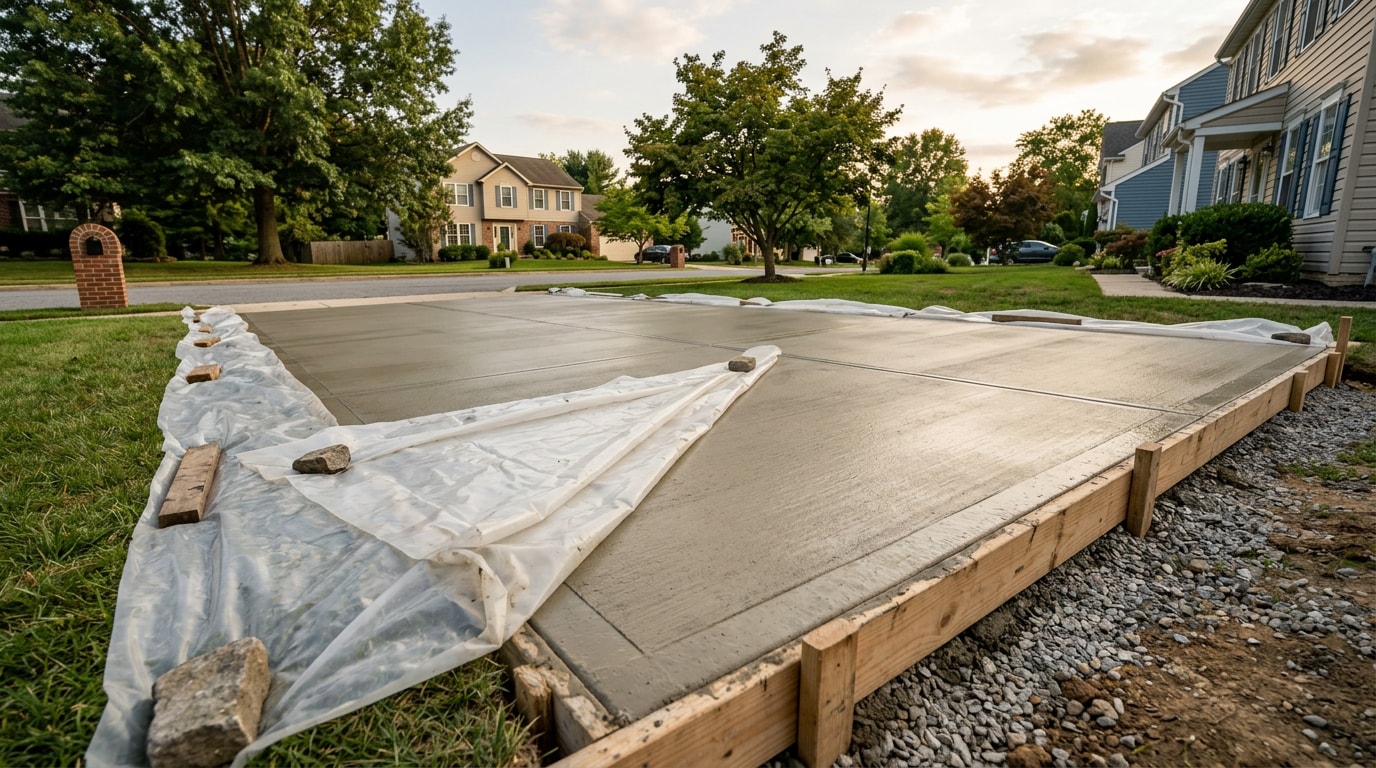
How much concrete you need in Baltimore County, MD comes down to one formula and a thickness decision, not guesswork. Get either number wrong and you either run short mid-pour or pay for yards you never needed. Below is the math, the local code minimums that actually change your total, and the ordering calls our crews get asked about on nearly every driveway and patio job.
How Thick Should Concrete Be for Your Project?
Thickness is the single biggest lever on your final yardage, and it's not one-size-fits-all across Baltimore County.
- Sidewalks and patios: 4 inches is standard for foot traffic.
- Private driveways: 4 to 6 inches, depending on vehicle weight.
- Heavy equipment or commercial areas: 6 inches or more.
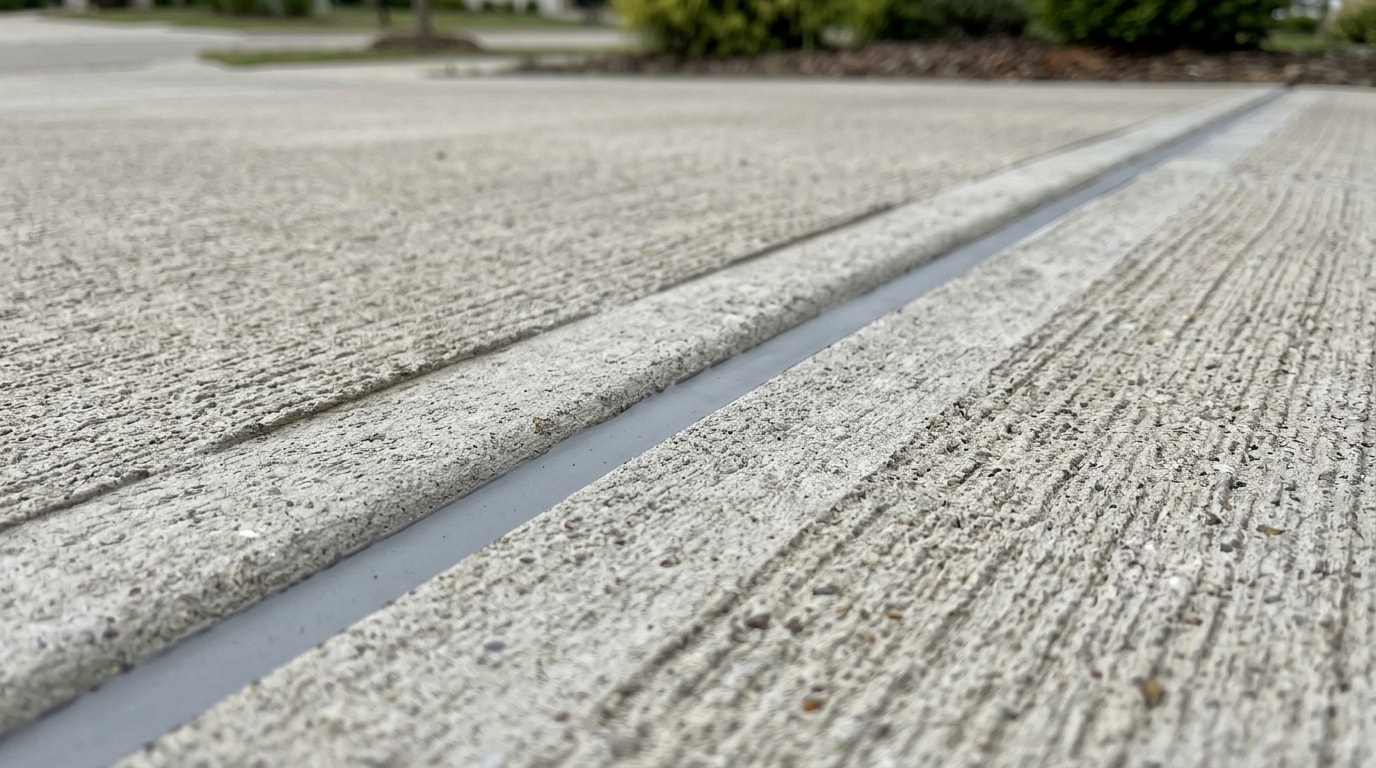
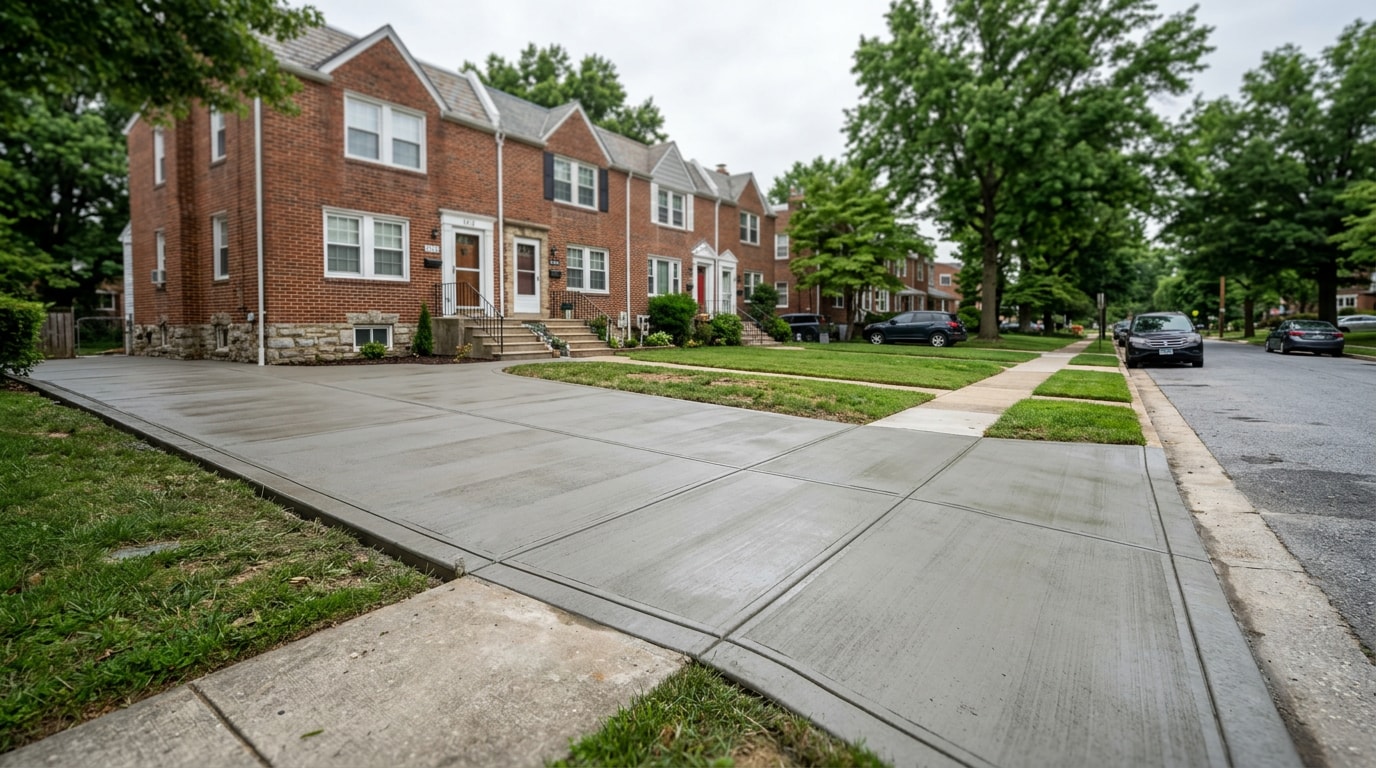
Here's the part most homeowners miss: the portion of your driveway that crosses the public right-of-way isn't governed by the same minimum as the rest of your slab. Baltimore County's Residential Access Permit sets a specific standard for that section. All driveway aprons and adjoining sidewalk must be concrete, seven inches thick minimum, of County-approved concrete mix. That's notably thicker than the general code floor for residential slabs: floors shall be a minimum 3.5 inches thick under the International Residential Code. If your project touches the apron or a public sidewalk panel, plan on the county's 7-inch figure for that section and the lighter 4 to 6-inch range for the private part of the slab.
On the clay-heavy soils common across the county, skimping on depth is a common mistake. Freeze-thaw cycles can heave thin slabs over a few winters, which is why most local contractors lean toward the higher end of a given range rather than the bare minimum. If you're unsure which standard applies to your layout, our concrete contractor team can confirm it before you order, and homeowners in the Baltimore County service area can get that checked as part of a free estimate.
Wait, I need to double check that link format.
# How Much Concrete Do I Need in Baltimore County, MD? (2026 Guide)
How much concrete you need in Baltimore County, MD comes down to one formula and a thickness decision, not guesswork. Get either number wrong and you either run short mid-pour or pay for yards you never needed. Below is the math, the local code minimums that actually move your total, and the ordering calls our crews field on nearly every driveway and patio job in the county.
How Thick Should Concrete Be for Your Project?
Thickness is the single biggest lever on your final yardage, and it isn't one-size-fits-all across Baltimore County.
- Sidewalks and patios: 4 inches is standard for foot traffic.
- Private driveways: 4 to 6 inches, depending on vehicle weight.
- Heavy equipment or commercial pads: 6 inches or more.
Here's the part most homeowners miss: the section of driveway that crosses the public right-of-way isn't governed by the same minimum as the rest of the slab. Baltimore County's Residential Access Permit sets its own standard for that strip. All driveway aprons and adjoining sidewalk must be concrete, seven inches thick minimum, of County-approved concrete mix. That's noticeably thicker than the general code floor used for an ordinary residential slab, where floors shall be a minimum 3.5 inches thick under the International Residential Code. If your project touches the apron or a county sidewalk panel, budget the 7-inch figure for that strip and the lighter 4 to 6-inch range for the private portion of the slab.
On the clay-heavy soils common across the county, skimping on depth is a frequent mistake. Freeze-thaw cycles can heave thin slabs over a few winters, which is why we typically push toward the higher end of a given range rather than the bare minimum. If you're not sure which standard applies to your layout, a concrete contractor can confirm it before you order, and homeowners anywhere in the Baltimore County service area can get that checked as part of a free estimate.
How to Calculate How Many Yards of Concrete You Need
Measure the length and width of the area in feet, then multiply by the thickness in feet (inches divided by 12). That gives you cubic feet; divide by 27 to convert to cubic yards, which is how ready-mix concrete is sold and ordered.
Here's the formula: length (ft) × width (ft) × thickness (ft) ÷ 27 = cubic yards.
Say you're pouring a typical rowhome-style driveway in a Baltimore County neighborhood: 18 feet long by 9 feet wide, at a 5-inch thickness.
- Convert 5 inches to feet: 5 ÷ 12 = 0.417.
- Multiply: 18 × 9 × 0.417 = 67.5 cubic feet.
- Divide by 27: roughly 2.5 cubic yards.
A one-inch error in thickness on that same slab changes the order by about half a yard, which is a real swing in both cost and whether the truck runs short.
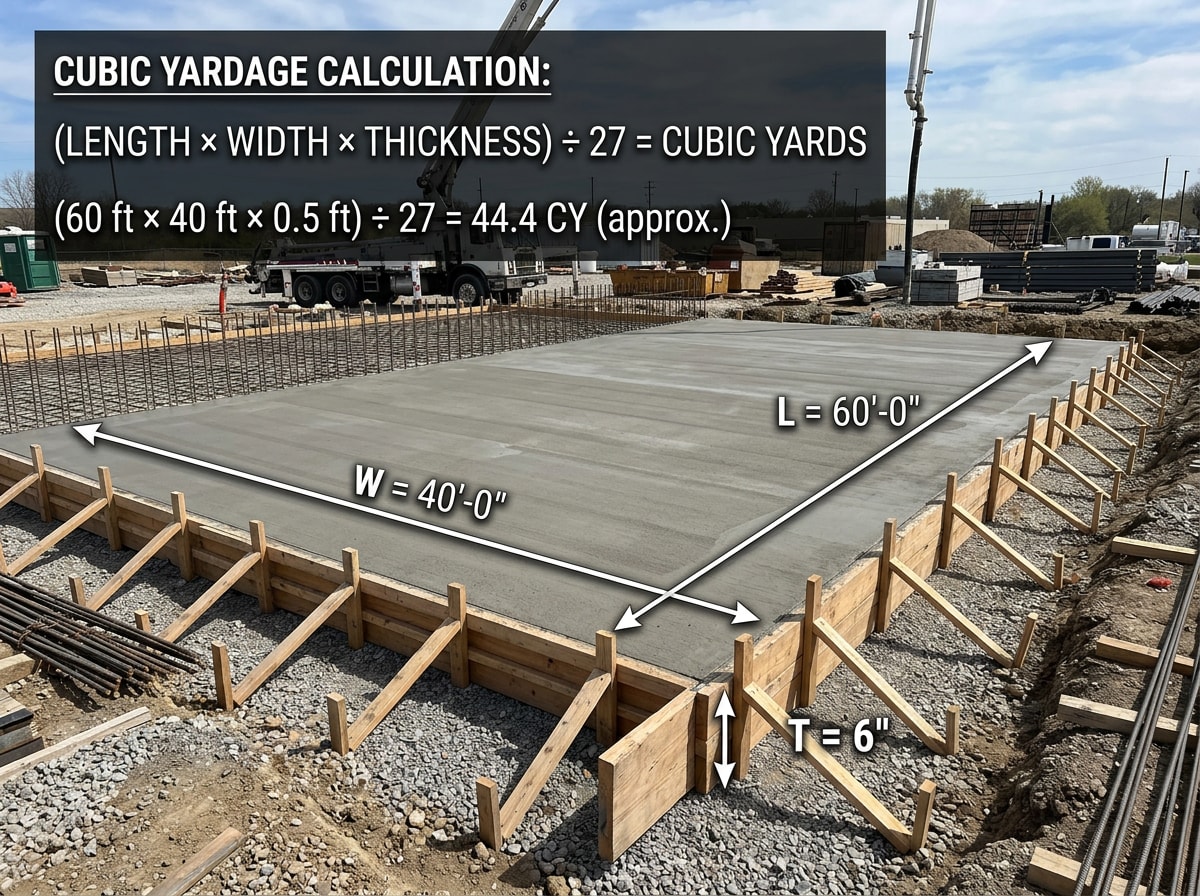
For irregular shapes, an L-shaped patio or a driveway with a curved apron, break the area into smaller rectangles, calculate each one separately, and add the totals together. If you're planning a full driveway replacement, our concrete driveway installation page covers what a professional pour looks like from prep to finish, and uneven lots often need grading and compaction before the forms even go in.
How Much Concrete Do You Need for Common Projects?
Most homeowners don't want to run formulas for every project, so here's a quick-reference table sized to common Baltimore County driveway and patio dimensions.
| Project | Size | Thickness | Cubic Yards Needed |
|---|---|---|---|
| Small patio | 10 ft × 10 ft | 4 in | 1.24 |
| Walkway | 3 ft × 20 ft | 4 in | 0.74 |
| Single-car driveway | 10 ft × 20 ft | 5 in | 3.09 |
| Two-car driveway | 18 ft × 20 ft | 6 in | 6.67 |
| Small footing/pad | 4 ft × 4 ft | 8 in | 0.4 |
Notice how much thickness alone changes the number. The same 10x10 slab at 6 inches instead of 4 jumps to about 1.85 cubic yards, nearly 50% more material for a 2-inch difference. That's why confirming thickness before ordering matters more than most people expect, and why our concrete patio installation estimates always start with an on-site measurement rather than a phone-quoted guess.
How Many Bags of Concrete Do I Need?
For smaller jobs, steps, fence post holes, small pads, bagged mix is often more practical than scheduling a ready-mix truck. The math is the same volume calculation, just converted into bag count instead of cubic yards.
- An 80 lb bag yields about 0.6 cubic feet of mixed concrete.
- A 60 lb bag yields about 0.45 cubic feet.
- A 40 lb bag yields about 0.3 cubic feet.
Divide your project's total cubic feet by the bag's yield, then round up. A full cubic yard (27 cubic feet) takes roughly 45 bags at 80 lb, or 60 bags at 60 lb. Bag yield can vary slightly by manufacturer and mix design, so check the actual label figures before buying in bulk.
How Much Does Concrete Weigh?
Weight matters separately from volume because it affects truck access, driveway load limits during a pour, and disposal planning if you're breaking out an old slab. Normal-weight concrete is commonly figured at about 150 pounds per cubic foot, which works out to roughly 4,050 pounds per cubic yard. That figure can shift slightly depending on the aggregate type and any additives in the mix design, but it's a reliable number for estimating truck loads and haul-away weight on a demolition or debris removal job.
What Does "A Yard of Concrete" Actually Mean?
A "yard" of concrete isn't a linear measurement; it's short for a cubic yard, equal to 27 cubic feet (3 feet × 3 feet × 3 feet). This is the standard unit ready-mix suppliers use for ordering, pricing, and delivery, regardless of the shape of your project.
Going back to the earlier driveway example, that 2.5-cubic-yard pour fills a space equivalent to roughly 13.5 feet by 13.5 feet at one foot deep, or spreads much thinner across a larger area like a driveway. One cubic yard alone covers about 80 square feet at a 4-inch thickness, a useful number for sanity-checking your own measurements.
How Much Extra Concrete Should You Order?
Ordering the exact calculated amount is risky, because uneven ground, minor spillage, and small measurement errors can all eat into your total before the pour is finished. The industry's own ordering guidance backs this up: quantity of concrete ordered should be 4% to 10% more than an estimate calculated from the plan dimensions to account for contingencies , according to the National Ready Mixed Concrete Association.
Older Baltimore County lots with inconsistent subgrade depth, irregular shapes, or sloped yards often justify leaning toward the higher end of that range. Timing matters too. If rain is in the forecast around your pour date, read our guide on pouring concrete in the rain in Baltimore County before you lock in a delivery window.
Bagged Concrete vs. Ready-Mix: Which Should You Order?
Bagged mix makes sense for projects under about half a cubic yard, small pads, steps, or post footings, where hauling bags and a mixer is manageable. Beyond that, ready-mix delivery becomes more cost-effective per yard, delivers more consistent strength, and saves significant labor.
Ready-mix trucks carry a lot more volume than most homeowners expect. The capacity of truck mixers varies between 8 to 12 cubic yards , so most suppliers set a practical order minimum, often around 1 cubic yard, with short-load fees applied below that threshold.
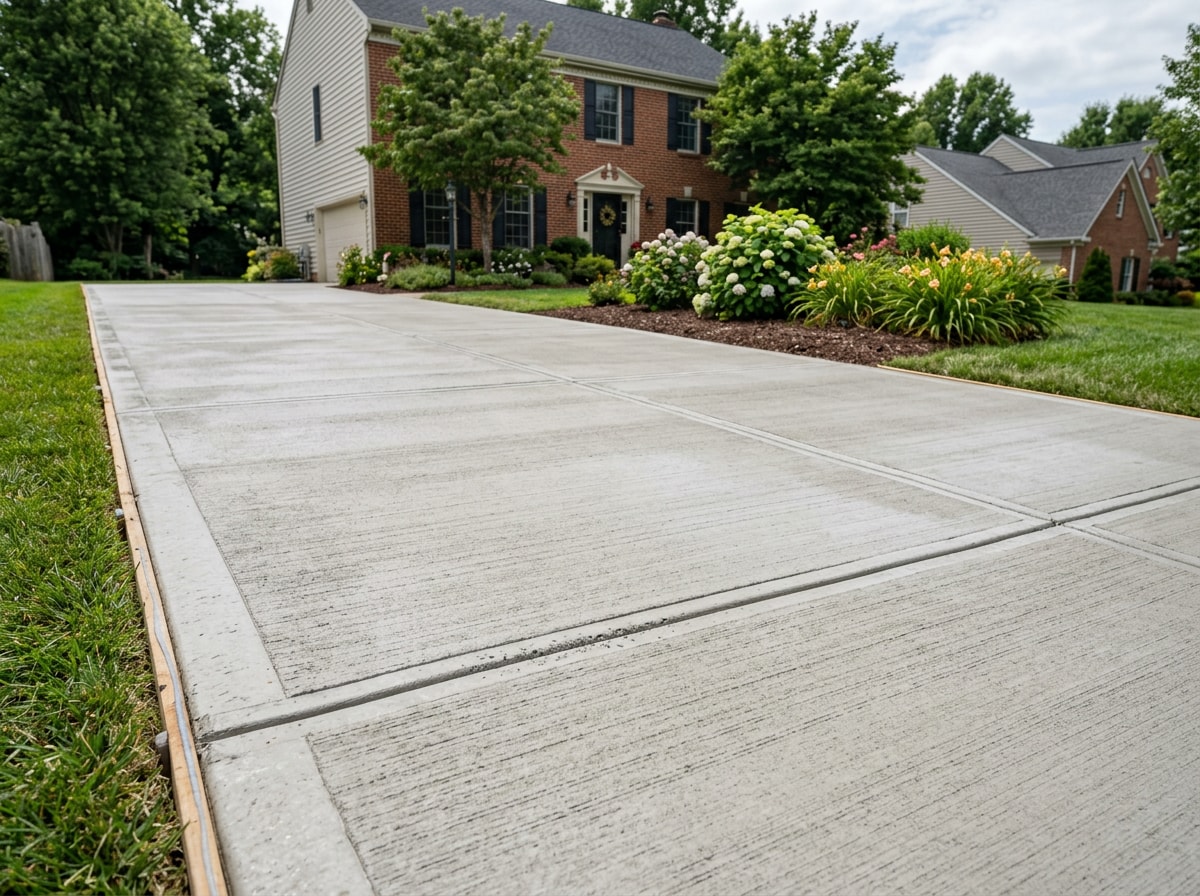
Jobsite access is another factor worth weighing. Narrow rowhome driveways, tight alley access, and some HOA restrictions common across Baltimore County neighborhoods can limit where a full-size truck can reach, which sometimes tips the decision back toward bagged mix or a pump truck add-on. If you're weighing options for a new outdoor living space, start with a free estimate so a crew can walk the site and tell you which route actually saves money.
Frequently Asked Questions
How many 80 lb bags of concrete make a yard?
It takes roughly 45 bags of 80 lb pre-mixed concrete to make one full cubic yard, since each bag yields about 0.6 cubic feet. See the bags section above for the full breakdown by bag size.
How much does a yard of concrete cost in Baltimore County?
Ready-mix pricing varies by PSI strength, delivery distance, and order size, so the only reliable number is a local quote. Get a free estimate for your specific project and mix requirements.
How much concrete do I need for a 10x10 slab?
A 10x10 slab needs about 1.24 cubic yards at a standard 4-inch thickness, or roughly 1.85 cubic yards at 6 inches. See the project table above for sizing comparisons.
How thick does my driveway need to be in Baltimore County?
Private driveway sections typically run 4 to 6 inches depending on vehicle weight. The apron and any sidewalk crossing within the county right-of-way must meet the county's 7-inch minimum under the Residential Access Permit standard.
How much does a yard of concrete weigh?
Normal-weight concrete runs about 150 pounds per cubic foot, which comes out to roughly 4,050 pounds for a full cubic yard. That figure shifts slightly with aggregate type and mix design.
What's the minimum amount of concrete a ready-mix company will deliver?
Most ready-mix suppliers set a truck minimum around 1 cubic yard, charging a short-load fee for anything below that amount. For smaller Baltimore County jobs under that threshold, bagged concrete is often the more practical and affordable choice.
Ready to get an exact number for your project instead of an estimate? Request a free estimate and a crew from SEJ Paving will measure, calculate, and quote your Baltimore County pour.